
"Only when the tide goes out do you discover who's been swimming naked." — Warren Buffett
The traditional process has four properties, and each one is a way of losing money.
1. Sequential, not parallel. A deal-killer is not 10x less likely to surface in hour 50 as opposed to in hour 5, and by hour 50 the time and money are already wasted.
2. Reactive, not anticipatory. Diligence workflows are built around known categories of risk. Novel or hyperlocal risks sit outside the standard template, which is exactly why they are the ones that hurt.
3. Human-bandwidth-constrained. Even the best deal teams face a hard ceiling on how many data sources they can meaningfully interrogate inside a 30 day exclusivity window.
4. Optimism-biased. Once a team is inside exclusivity, the psychological and financial incentives point towards confirming the thesis, not challenging it.
Put together, they produce a systematic underproduction of risk assessment at the exact moment it matters most. Two real cases below show where Starboard picked up what investors missed.
Fire flow sinks a Miami warehouse
In 2022 a publicly traded REIT with more than $5bn in assets identified a well-located Class B warehouse in Miami-Dade County as a value-add acquisition. The thesis was simple: buy at a discount to replacement cost, raise clear heights from 32 to 36 feet, and reposition to capture logistics tenants paying premiums for modern high-bay space.
The underwriting penciled. Strong last-mile positioning, proximity to the Port of Miami, good highway access. The structural report confirmed the building could take the ceiling raise. The team moved quickly into exclusivity.
What they missed
Not the sprinklers. The ceiling raise meant a new ESFR system designed to the taller roof, which nobody disputed: ESFR is standard for high-bay, its design criteria come out of NFPA 13 as adopted by the Florida Fire Prevention Code, and every industrial team in the country budgets a fire pump alongside it, because municipal pressure on its own is almost never enough for ESFR anywhere. The pump was in the budget.
The pump was also beside the point. A fire pump raises pressure. It cannot create flow that the main does not have.
The ESFR design at the new roof height needed roughly 2,000 gpm at the riser plus a 250 gpm hose allowance. The hydrant test came back at 1,100. The main was an 8-inch line laid in 1971, undersized for what the block had become and already on the water department's replacement list.
That left two ways to keep the plan alive. A storage tank and pump house would have solved the flow problem for about $750,000, but needed 4,000 square feet of truck court the site could not give up without losing six trailer stalls. Upsizing the main meant $1.8m of unbudgeted cost and an 18-month coordination window with the utility, which the financing structure could not absorb. The REIT walked, writing off nine months of work and roughly $400,000 in due diligence costs.
Here is the part worth sitting with. The public record never held the number that killed this deal. Available fire flow comes from a hydrant test you have to request, and the utility's letter of availability is a per-project document that confers no vested rights on anybody. What the public record did hold was every reason to order that test in week one: the main's age and diameter, the county's own capital programme flagging the block for replacement, and adjacent-property permits where prior tenants had hit the same wall. Three sources, none of them secret, none of them on the checklist. The test was ordered in month three, after the $400,000 had already been spent and overpaying for the site.
A Georgia site with nowhere to send the sewage
A regional multifamily developer with a strong Southeast track record identified a parcel in a fast-growing suburban Atlanta corridor as the site for a 100+ unit garden-style community. The land basis was attractive and the market fundamentals were strong: comparable properties in the submarket were posting rent growth well above both the national average and peer markets. The developer secured an option and began working through entitlements. The local planning commission was supportive. Groundbreaking looked twelve months out.
What they missed
Georgia's suburban growth corridors have been among the fastest-developing regions in the country for the better part of a decade, and in several of them, wastewater treatment capacity has not kept pace with residential approvals. The relevant county utility authority runs its own capacity allocation programme, and that programme is not integrated with the planning department's entitlement process. Planning can therefore approve a project the utility authority has no capacity to serve.
Four weeks in, with construction financing already being lined up, the developer learned this from a different broker who happened to know someone at the utility authority: no additional sewer capacity would be available in the service district for at least 48 months, pending a treatment plant expansion that was itself subject to permitting delays.
None of the alternatives worked. A private package treatment plant meant $2.2m of additional capital cost and permanent operational complexity. The other two options were a multi-year hold on an optioned land position, or a negotiated exit at a loss. The developer exited, absorbing a $600,000 write-off across option payments, predevelopment costs and consultant fees.
Every treatment plant's permitted capacity is written into its NPDES permit, and its monthly flows go into discharge monitoring reports that the EPA publishes through its ECHO database. Divide one by the other and you have utilisation, plant by plant. The water authority's own master plan and board minutes explained the rest.
What agentic orchestration does differently
Most AI in diligence is a reading accelerant: it speeds up the review of documents a human has already decided to review. That leaves the binding constraint untouched, because in both cases above the failure was not slow reading. It was that nobody went looking.
Starboard is built the other way round. The platform deploys a coordinated system of specialised agents, each owning a distinct risk domain, running in parallel and in dialogue with one another across a search space no human team could cover or even hold in their head all at once. The agents work from the business plan, not from a checklist: tell the system you intend to raise clear heights to 36 feet, and available fire flow becomes a question it knows to ask in week one.
The compounding value of breadth
The cases above are point-in-time discovery, which is the easiest version of the argument to make but also the least interesting. The orchestration layer compounds in three ways that matter more.
Cross-domain risk synthesis. Individual risk factors interact. A property with marginal flood risk, aging utility infrastructure and a municipality under fiscal stress is a materially different asset from one carrying any of those alone. Human deal teams rarely have the bandwidth to model the interactions explicitly. Starboard's agents share findings across domains and produce a synthesised risk narrative that reflects the interaction effects, rather than just an itemised list of separate concerns.
Portfolio-level pattern recognition. Across a portfolio, the orchestration layer surfaces systemic exposures that asset-by-asset review cannot see: a concentration in municipalities with deteriorating infrastructure credit, say, or an overweight in markets facing a contracting insurance market. In Starboard's Sandbox a firm can sensitise its whole portfolio against underwritings it has actually done, and catch the risks before the risks catch it.
Monitoring that does not stop at closing. Zoning ordinances change. Infrastructure constraints worsen. Regulatory environments shift. Agents running continuously alert asset managers to material changes in the risk environment of existing holdings, which turns diligence from a one-time exercise into a permanent capability.
Where this leaves the industry
The data needed to make better investment decisions has never been more available, and the gap between the teams who can systematically reach and synthesise it and the teams who cannot will continue to widen. The barrier is no longer cost, because most of what would have flagged those two deals was free. The barriers are structural: human bandwidth, domain fragmentation, and workflow design. Starboard's agentic orchestration addresses all three.
For institutional investors the implication is uncomfortable but simple. The traditional diligence process, however well-staffed, is no longer the benchmark of fiduciary responsibility. The new floor is now set by the orchestration layer a team deploys: its breadth of search, its depth of domain knowledge, and its ability to turn cross-domain signals into something an IC can act on.
The deals that define the next fund's performance will not be won by the teams that work harder in diligence. They will be won by the teams that see more, sooner, and act on what they find.
If you have a deal with an esoteric risk in it, we would love to plug it into Starboard with you and see how quickly Starboard finds it.
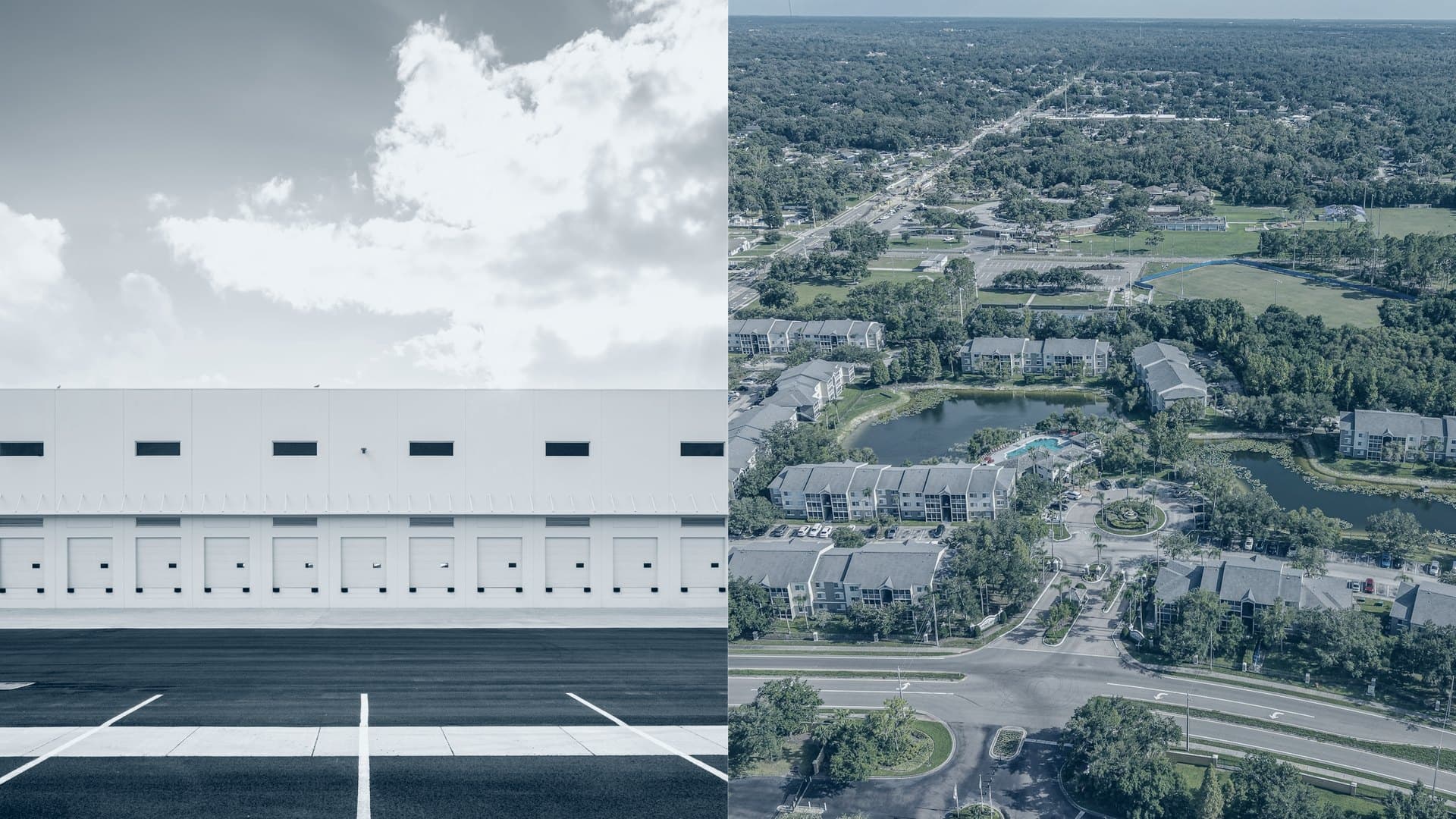
Header photographs: a distribution warehouse loading dock in Miami, Florida, by Ryan Parker on Unsplash, and a garden-style apartment community seen from the air, by Chris Grant on Unsplash. Both are toned to match; neither depicts a property named in this article.